Texas has more than a mineral opportunity
Rare earth elements are strategically important, but a resource in the ground is not the same thing as an industrial capability. The U.S. Geological Survey reports that rare earths were mined and processed domestically in 2025, while imported rare-earth compounds and metals still remained part of the U.S. supply picture. The larger industrial challenge is the ability to process, separate, refine, qualify and manufacture materials reliably at scale.
AFFRE’s Texas First framework begins with that distinction. Mining creates access to a resource. Engineering, chemistry and manufacturing create the capability to transform that resource into something American industry can use.
Why Texas is positioned to build the middle of the supply chain
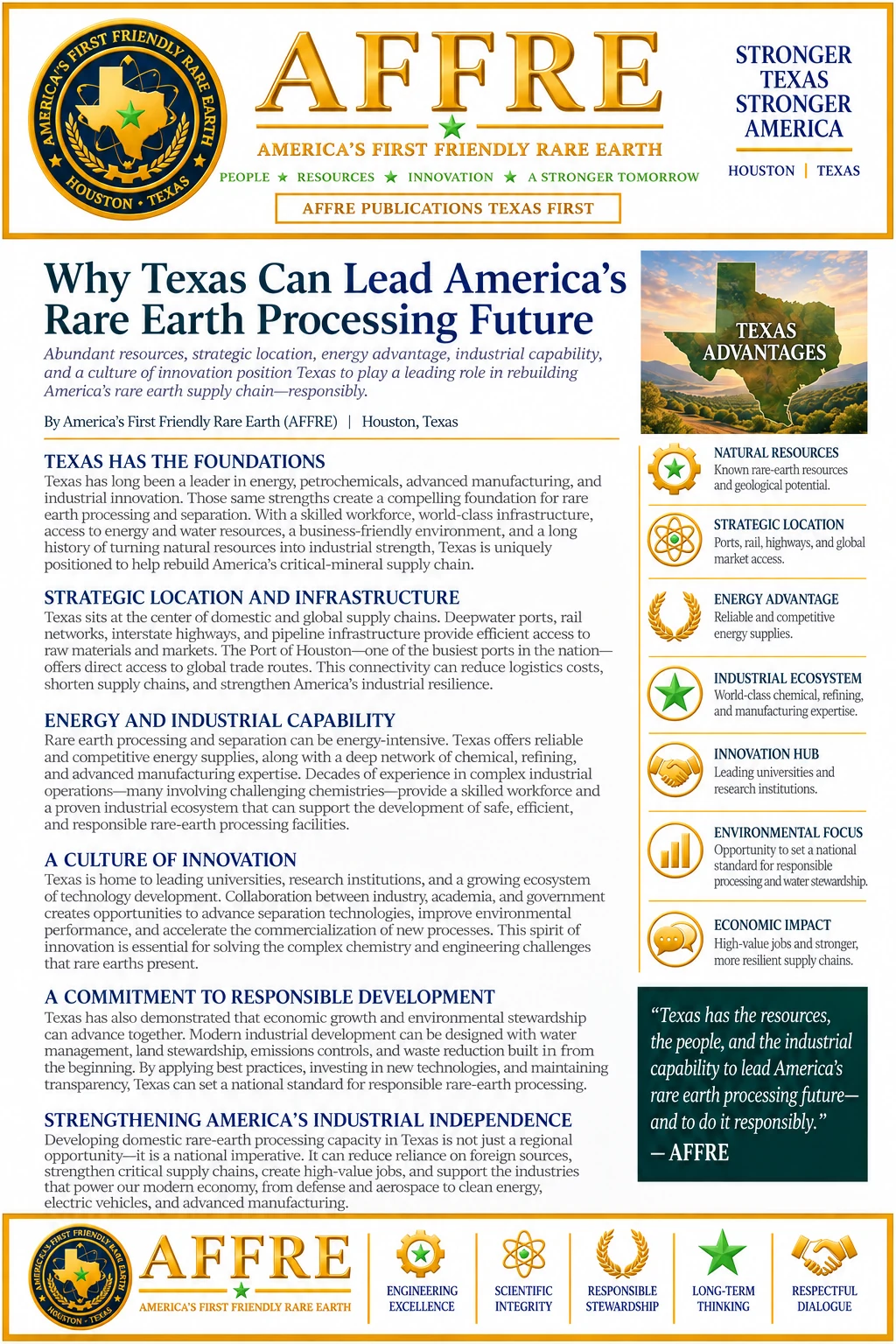
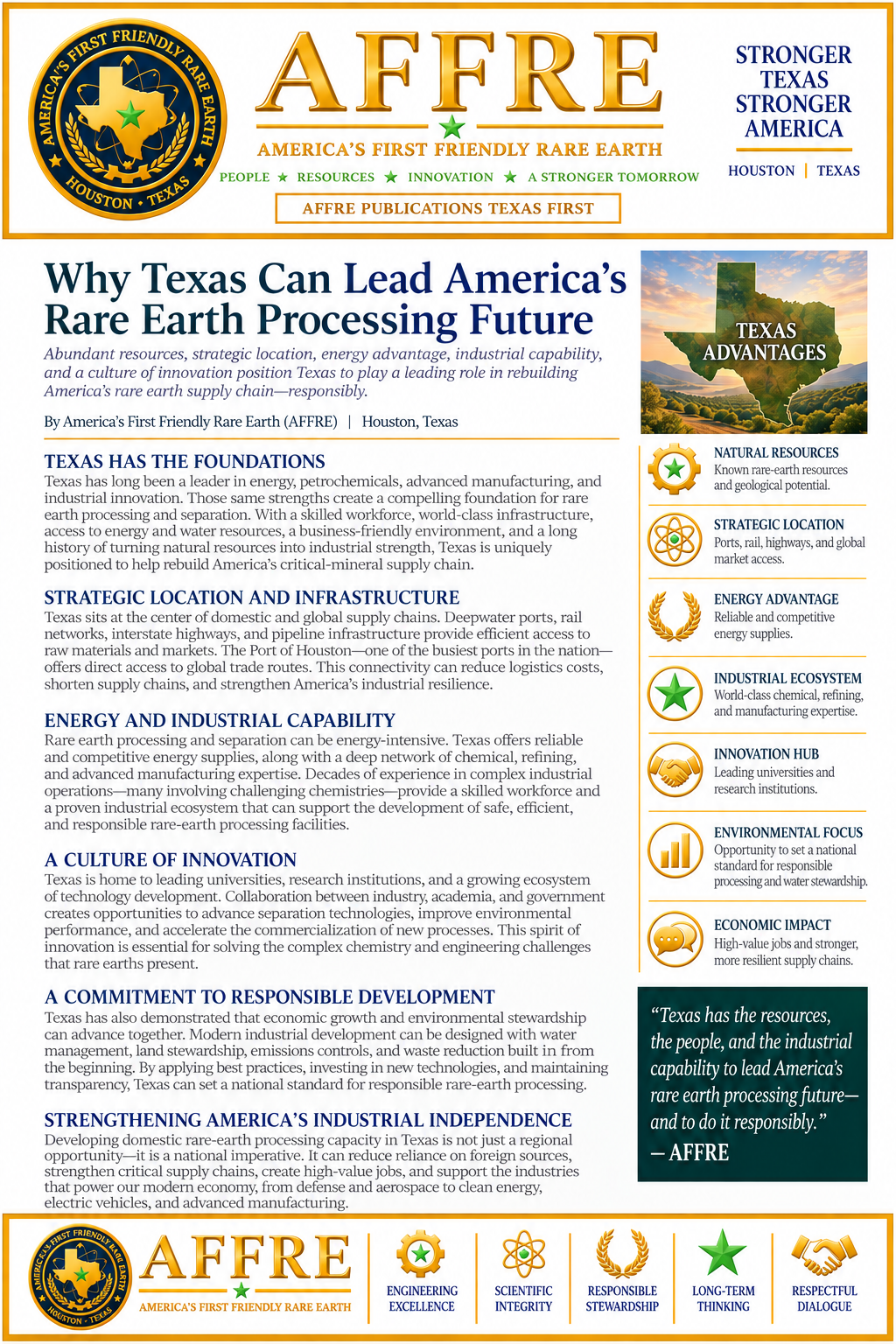
Texas already operates many of the systems that rare earth processing and separation depend upon: chemical and process engineering, large-scale industrial operations, fabrication, automation, transportation, power, finance, construction, research and technical workforce development. The state’s own economic-development strategy identifies advanced manufacturing, rare earth elements and mineral mining, energy, and transportation and logistics as targeted industry sectors.
That matters because rare earth processing is not a single machine or a single chemistry step. It is a system. It requires engineering disciplines to work together across process design, controls, materials handling, water management, environmental performance, product quality, maintenance and scale-up.
Industrial and engineering depth
Texas produces a significant share of U.S. manufactured goods and has deep capabilities in petrochemicals, aerospace, electronics, semiconductors, heavy machinery and energy. Houston adds decades of refinery and petrochemical operating discipline, chemical and process-engineering talent, industrial services, fabrication and global commercial experience.
AFFRE does not view those capabilities as proof that Texas automatically wins in rare earths. It views them as a strong platform from which serious evaluation can begin.
Logistics that connect resources to markets
Texas is built for movement. The Governor’s Office lists 23 seaports, including 12 deep-water ports, extensive freight rail and roadway networks, and a large system of foreign trade zones. Port Houston is identified by the state as the largest Gulf Coast container port and the top U.S. port for waterborne tonnage.
For a future rare earth ecosystem, logistics matter at every stage: incoming feedstocks, reagents and equipment; movement of process modules; shipment of intermediate products; and delivery to downstream manufacturers and customers.
Energy and operating infrastructure
Processing and advanced manufacturing require dependable energy, utilities, industrial sites and an operating culture that understands capital-intensive systems. Texas’s scale in oil and gas, wind, utility-scale solar, battery storage and industrial power infrastructure creates a broad base for evaluating different process configurations and future energy strategies.
Rare earth development is already becoming part of Texas’s industrial strategy
Texas is not starting from zero. In May 2026, the State announced a $14.1776 million Texas Semiconductor Innovation Fund grant to USA Rare Earth to accelerate development of the Round Top Mountain project in Hudspeth County. The project is expected by the State to represent more than $1.4 billion in capital investment and to develop a domestic source of heavy rare earth elements and selected technology metals.
That investment illustrates a broader point: rare earth resources increasingly intersect with semiconductors, advanced manufacturing, national supply-chain resilience and technology policy. AFFRE’s proposed contribution sits in a complementary part of that chain - processing, separation, pilot demonstration, scale-up and the engineering required to connect feedstocks with usable materials.
Processing and separation are where capability is created
Federal investment priorities point in the same direction. In 2026, the U.S. Department of Energy announced multiple programs supporting pilot-scale rare earth processing, recovery and refining projects. DOE has described these programs as efforts to fill domestic supply-chain gaps and strengthen U.S. capabilities across mining, processing and manufacturing.
For AFFRE, the lesson is straightforward: America’s rare earth opportunity cannot be measured only by what is discovered or mined. It must also be measured by whether the country can reliably separate and process materials into qualified products.
Responsible development should be engineered in from the beginning
AFFRE’s use of the word Friendly is intended to carry an operating responsibility. Industrial capability and environmental stewardship should not be treated as opposing ideas. Good engineering should attempt to solve for both.
That is why water, process chemistry, residual materials, land disturbance, safety, monitoring and lifecycle consequences belong inside the engineering problem from the start. AFFRE’s method is to study, engineer, test, prove, improve and scale - with claims made only in proportion to evidence.
Water stewardship
AFFRE’s aspiration is simple to state and demanding to prove: when water is entrusted to a process, the goal is to return it to the Earth as it was given to us - or better. That is an objective, not a performance claim. It must ultimately be supported by process design, measurement, treatment standards, monitoring and independently reviewable evidence.
This is the discipline behind AFFRE’s broader principle: Protect. Prove. Scale.
Why Houston matters
Houston is a natural place to organize the engineering side of a Texas rare earth ecosystem. The region’s chemical and process-engineering depth, industrial operating experience, ports, fabrication capabilities, technical services, research institutions and global commercial connections are directly relevant to the challenge of moving a process from concept to pilot, from pilot to demonstration, and from demonstration toward dependable commercial operation.
The opportunity is larger than one mine, one plant, one company or one technology. A durable system can connect resource developers, universities, laboratories, engineers, equipment suppliers, manufacturers, workforce institutions, investors, customers and public agencies - each with clear responsibilities and evidence-based decision gates.
The Texas opportunity
Texas has the ingredients to evaluate a rare earth processing and separation capability with unusual seriousness: resources, engineers, industrial infrastructure, manufacturing, logistics, energy, research, capital and an established culture of building complex systems.
The responsible path is not to declare the outcome in advance. It is to validate the chemistry, define the environmental and economic requirements, test performance at appropriate scale, protect public and private value, and expand only when evidence supports the next step.
That is the opportunity AFFRE sees in Texas: not simply to produce more raw material, but to help build an enduring American capability - engineered in Texas, measured by evidence, and designed with long-term stewardship in mind.
Sources and further reading
- U.S. Geological Survey, Mineral Commodity Summaries 2026, Rare Earths.
- Office of the Texas Governor, Top Texas Touts: Infrastructure, updated July 8, 2026.
- Office of the Texas Governor, Advanced Manufacturing.
- Office of the Texas Governor, Target Industry Sectors, including Rare Earth Elements and Mineral Mining.
- Office of the Texas Governor, Texas Semiconductor Innovation Fund grant to USA Rare Earth, May 12, 2026.
- U.S. Department of Energy, $45.7 million for domestic critical mineral and material supply chains, May 19, 2026.
- U.S. Department of Energy, $134 million to bolster rare earth element supply chains, June 2, 2026.
AFFRE distinguishes established facts from engineering objectives and future possibilities. Project-specific performance claims require testing, validation and appropriate technical review before external representation as established fact.