The name can be misleading: rare earths are not necessarily rare
'Rare earth' sounds like a description of scarcity. The geology is more nuanced. The U.S. Geological Survey describes rare earths as a relatively abundant group of elements, while also noting that economically workable concentrations are much less common. The strategic problem is therefore not simply whether rare earth elements exist. It is whether resources can be developed and then transformed into materials that industry can actually use.
Resources are only the beginning
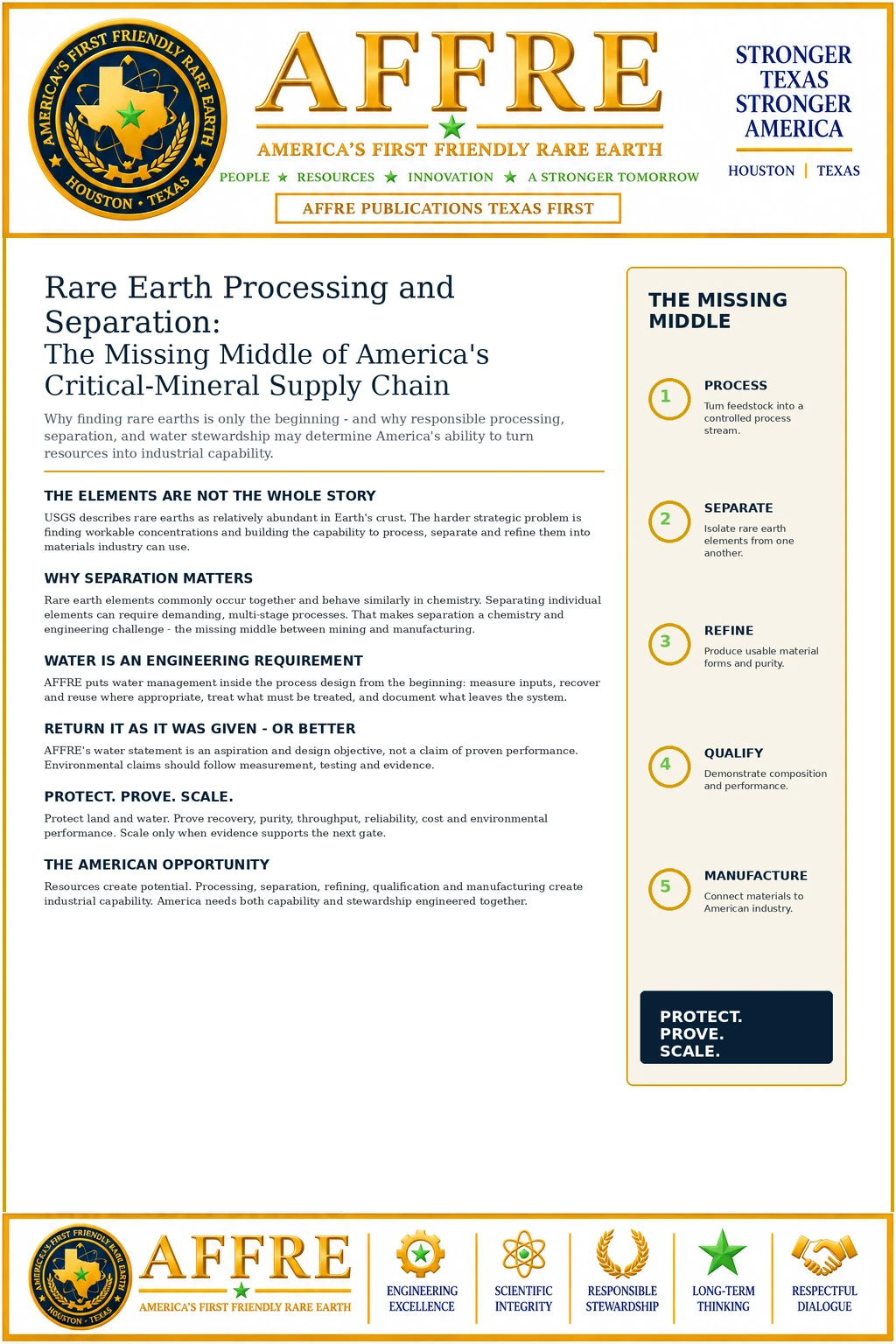
A mineral resource represents potential. Potential becomes industrial capability only after a chain of difficult steps: beneficiation, processing, separation, refining, qualification, manufacturing and reliable delivery.
That middle of the chain matters because rare earth elements commonly occur together and have closely related chemical behavior. The U.S. Department of Energy has described separation as chemically intensive because individual rare earth elements are so similar to one another. The result is a demanding engineering problem, not merely a mining problem.
Why separation is the missing middle
Mining can produce ore or concentrate. Manufacturers, however, need materials with defined composition, purity and performance. Between those endpoints lies the missing middle: the chemical and process-engineering capability required to isolate individual rare earths, refine them into usable forms, qualify products and supply downstream manufacturers consistently.
DOE has specifically identified domestic midstream capability - including separation of rare earth oxides and processing of rare earth metals and alloys - as an important constraint on domestic manufacturing growth. Current federal projects continue to fund pilot-scale processing, separation, recovery and refining technologies, underscoring how strategically important this stage remains.
Why rare earth separation is difficult
Rare earth elements share similar physical and chemical properties. Those similarities are useful in many applications, but they complicate purification. Conventional industrial separation has relied heavily on solvent extraction, often through many stages, because the chemical differences among neighboring rare earths can be small.
That challenge creates room for better process design. DOE-supported work now includes continuous ion exchange and other approaches intended to improve selectivity, efficiency, scalability or environmental performance. The objective is not innovation for its own sake. It is dependable, measurable industrial performance.
Build capability responsibly
Rebuilding domestic rare earth capability creates an opportunity to ask more of the next generation of processing systems. Environmental performance should not be treated as something added after the chemistry and equipment have already been chosen. Land, water, residual materials, energy, safety, monitoring and lifecycle consequences belong inside the engineering problem from the beginning.
For AFFRE, that is what the word Friendly is intended to mean: engineering and scientific discipline that seeks industrial strength and responsible stewardship at the same time. It is an operating responsibility, not a decorative claim.
Water is an engineering requirement
Water deserves particular attention because process chemistry, feedstock, recovery systems, treatment requirements and discharge conditions can all affect environmental performance. A responsible design asks where water enters, how much is required, where it can be recovered or reused, what must be treated, how quality will be measured and what ultimately leaves the system.
That sentence is an aspiration and design objective, not a declaration of proven performance. AFFRE believes environmental claims should be supported by measurement, testing, documented standards and evidence. The standard is simple: claim only what the evidence supports.
Protect. Prove. Scale.
Protect
Put land, water, chemistry, safety, material handling and environmental performance inside the process design. Define boundaries, establish baselines and identify what must be measured before consequential decisions are made.
Prove
Test recovery, separation, purity, throughput, reliability, cost and environmental performance. Distinguish demonstrated results from engineering judgment, current development and future opportunity. Ideas become credible when they survive testing.
Scale
Expand only when technical, economic, operational and environmental evidence supports the next gate. A process that works at one scale or with one feedstock must still demonstrate that it can operate reliably as conditions change.
The opportunity before America
America can possess mineral resources without possessing every capability needed to transform them into advanced industrial products. The deeper strategic question is whether the country can build the chemistry, processing, separation, refining, qualification and manufacturing capabilities required to turn resources into enduring industrial strength.
AFFRE believes that question should be paired with another: can that capability be engineered with responsible stewardship from the beginning? Those objectives belong together. Protect the land. Protect the water. Prove the science. Then scale the solution.
Sources and further reading
- U.S. Geological Survey, Rare Earths Statistics and Information.
- U.S. Geological Survey, Rare Earth Elements - Critical Resources for High Technology.
- U.S. Department of Energy, Critical Materials Rare Earths Supply Chain: A Situational White Paper.
- U.S. Department of Energy, Next-Generation Technology for the Efficient Manufacturing Future.
- U.S. Department of Energy, Project Selections: Critical Material Innovation, Efficiency, and Alternatives.
AFFRE distinguishes established facts from engineering objectives and future possibilities. Project-specific performance and environmental claims require testing, validation and appropriate technical review before representation as established fact.